How to Select a 360° Reflector Mini Prism for Accurate Survey Measurements?
In the world of precision surveying, every millimeter matters. The 360° Reflector Mini Prism has become an essential tool for modern total station operations, offering surveyors the ability to capture accurate measurements from any direction without manual prism alignment. Unlike traditional single-face prisms that require constant orientation toward the instrument, a 360° Reflector Mini Prism enables seamless all-direction measurement, allowing robotic total stations to track and measure targets continuously.
But with various models and specifications available, how do you select the right 360° Reflector Mini Prism for your specific surveying needs? This guide will walk you through the key factors to consider.
What Is a 360° Reflector Mini Prism?
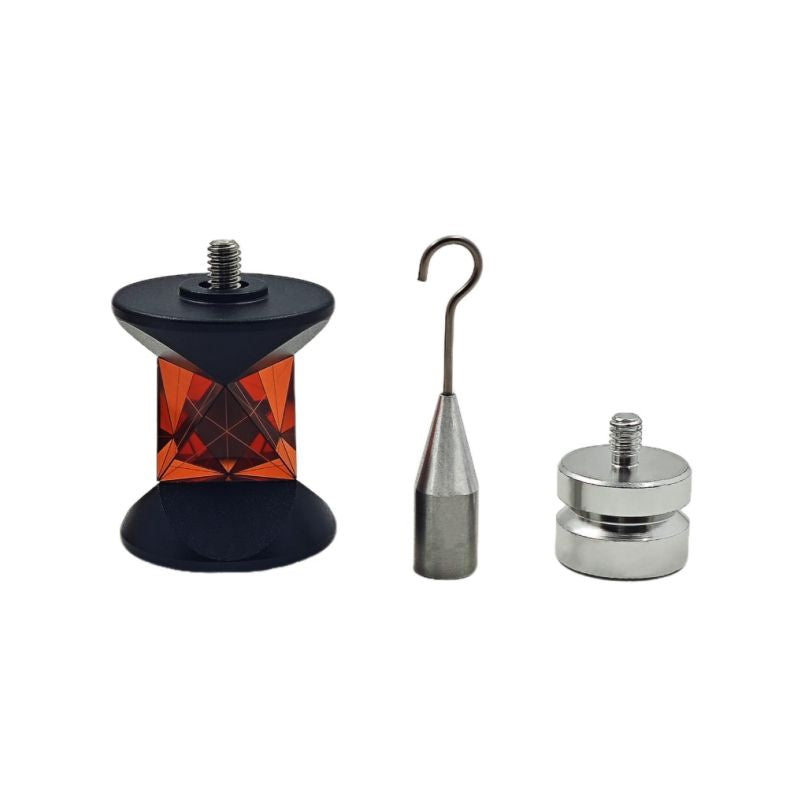
A 360° Reflector Mini Prism typically consists of six precisely aligned corner-cube prisms joined together in a ring configuration. This multi-prism assembly ensures that the electronic distance measurement (EDM) signal from the total station is reflected directly back to its source regardless of the angle of incidence. The even distribution of these prisms provides similar offset and accuracy readings from any side, making it ideal for dynamic measurement environments where the target moves or rotates.
Key Factors to Consider When Selecting a 360° Reflector Mini Prism
1. Accuracy and Precision
When selecting a 360° Reflector Mini Prism, accuracy should be your top priority. High-quality models deliver exceptional centering accuracy—typically within ±1.5 mm to ±2.0 mm. For instance, the GRZ101 360° Reflector Mini Prism provides a pointing accuracy of 1.5 mm, making it suitable for most precision surveying tasks. Some advanced monitoring prisms achieve even tighter tolerances, with ±0.2 mm accuracy during 360° rotation measurements.
Look for specifications such as beam deviation, typically measured in arcseconds—a lower number indicates higher precision. Models like the GRZ122 offer beam deviation as low as 3 arcsec, while others provide 5 arcsec precision.

2. Prism Constant and Compatibility
The prism constant is a critical specification that affects measurement accuracy. Different 360° Reflector Mini Prism models use different constants—commonly +23.1 mm, +28.1 mm, +29.0 mm, or +30.0 mm. Swiss-style prisms typically feature standardized constants that ensure compatibility with Swiss-style total stations.
Before purchasing a 360° Reflector Mini Prism, verify that its constant matches your total station’s configuration or can be properly calibrated in your instrument settings.
3. Working Range
The working range of a 360° Reflector Mini Prism determines how far from the total station it can be effectively used. Most mini prisms offer a working range of approximately 600 meters (2,000 feet). However, the automatic target recognition (ATR) range may be shorter—typically around 350 meters for compact models.
Consider your typical surveying distances when selecting a 360° Reflector Mini Prism. For short-range ATR applications, a compact mini prism is ideal. For longer-range work, you may need to consider standard-size reflectors.
4. Build Quality and Durability
Surveying environments can be harsh. A quality 360° Reflector Mini Prism should feature:
Copper coating for protection in extreme conditions
Weather-resistant construction and shock-absorbing design elements
High-grade optical glass for consistent signal reflection
Reinforced structure for long-term durability
5. Mounting Options and Accessories
A versatile 360° Reflector Mini Prism should offer flexible mounting options. Look for models with:
Multiple thread sizes (1/4" male/female, 5/8") for compatibility with standard poles
Integrated bubble levels for proper orientation
Complete kits including poles, adapters, and carrying cases
6. Application-Specific Needs
Different surveying applications require different features from a 360° Reflector Mini Prism:

Application:Recommended Prism Type
Deformation monitoring:High-precision 360° prism with tight tolerances
Construction layout:Compact 360° mini prism for efficiency
Machine control:360° prism with automated tracking capability
Topographic surveys:Standard 360° prism with good range
One-person surveying:360° mini prism for robotic total stations
Core Advantages of a Quality 360° Reflector Mini Prism
A premium 360° Reflector Mini Prism delivers several key benefits:
Elimination of prism orientation errors — reflects signals from any direction without requiring rotation or repositioning
Consistent centering accuracy — typically ±1.5 mm to ±2.0 mm
Reduced setup time — eliminates constant prism adjustment
Seamless robotic total station integration — enables automated target tracking
Compact and lightweight design — reduces survey kit burden
Full 360° horizontal signal reflection — no need to rotate the prism
Contact Mountlaser for Your 360° Reflector Mini Prism Needs
At Mountlaser, we understand that every surveying project has unique requirements. That's why we offer a comprehensive range of high-quality 360° Reflector Mini Prism solutions designed to meet the demands of professional surveyors worldwide. From the GRZ101 with 1.5 mm pinpoint accuracy to the ST360 with integrated bubble level and flexible height adjustment, our products are engineered for precision and durability in the field.
Whether you need a complete kit with poles and carrying case or a specific prism assembly for your Swiss-style total station, our team is ready to help you find the perfect 360° Reflector Mini Prism for your application. Contact Mountlaser today to discuss your requirements and get expert advice on selecting the right equipment for accurate, efficient surveying.
Purchasing Considerations for a 360° Reflector Mini Prism
Before making your purchase, keep these important considerations in mind:
Verify total station compatibility — Ensure the prism constant and mounting thread match your instrument
Check the prism constant — Different models use different offsets (+23.1mm, +28.1mm, +29.0mm, +30.0mm)
Evaluate the working range — Consider both standard range (typically 600m) and ATR range (typically 350m for mini prisms)
Inspect build quality — Look for copper coating, weather resistance, and durable construction
Consider the complete kit — Many models include poles, bubble levels, and carrying cases for better value
Assess environmental conditions — Consider temperature, humidity, and exposure to harsh elements
Check for obstructions — Ensure clear sight lines back to the total station

Summary
Selecting the right 360° Reflector Mini Prism for accurate survey measurements requires careful evaluation of accuracy specifications, prism constant compatibility, working range, build quality, mounting options, and your specific application needs. While standard single-face prisms may offer slightly higher absolute precision, the 360° Reflector Mini Prism provides unmatched convenience and efficiency in dynamic surveying environments—eliminating orientation errors, reducing setup time, and enabling seamless robotic total station operation. By understanding these key factors, you can choose a 360° Reflector Mini Prism that delivers the perfect balance of accuracy, durability, and productivity for your surveying projects.
360° Reflector Mini Prism Frequently Asked Questions
Q: What is the typical accuracy of a 360° Reflector Mini Prism?
A: High-quality models offer centering accuracy of ±1.5 mm to ±2.0 mm.
The GRZ101 model provides 1.5 mm pointing accuracy.
Some advanced monitoring prisms achieve ±0.2 mm during 360° rotation.
Always verify the exact specifications for your chosen model.
Q: What is the working range of a 360° Reflector Mini Prism?
A: Most models offer a standard working range of approximately 600 meters (2,000 feet).
The automatic target recognition (ATR) range is typically shorter, around 350 meters for compact mini prisms.
For longer distances, consider using a larger standard prism or ensuring optimal visibility conditions.
Q: What prism constant should I look for?
A: Prism constants vary by model. Common values include +23.1 mm, +28.1 mm, +29.0 mm, and +30.0 mm.
Choose a constant that matches your total station's configuration.
Most modern instruments allow you to input the constant manually.
If unsure, consult your total station manual or contact the manufacturer for guidance.
Q: Are 360° prisms as accurate as standard single prisms?
A: Standard single prisms generally offer higher absolute accuracy due to their simpler optical design.
However, a high-quality 360° Reflector Mini Prism provides excellent accuracy (typically within 1–2 mm).
It offers the significant advantage of all‑direction measurement without repositioning or rotating the prism.
For most construction, layout, and monitoring tasks, this accuracy difference is negligible compared to the productivity gains.
Q: What applications are best suited for a 360° Reflector Mini Prism?
A: This prism is ideal for robotic total station operations and one‑person surveying.
It excels in continuous tracking of moving targets, such as machine control and construction layout.
It is also widely used for deformation monitoring of structures and bridges.
Additionally, it works great for topographic surveys where maintaining prism orientation is difficult.
Q: How do I maintain my 360° Reflector Mini Prism?
A: Keep the prism glass clean and free from dust, dirt, or moisture.
Inspect the housing for any damage or loose parts before each use.
Avoid exposing the prism to extreme temperatures or direct sunlight for extended periods.
Store the prism in its protective carrying case when not in use.
Periodically check the bubble level (if equipped) and recalibrate if necessary.