One machine replaces multiple devices: How a Laser Collimator integrates calibration, alignment, and spot analysis?
In the fields of construction surveying, engineering measurement, and optical instrument maintenance, professionals have long struggled with a disjointed collection of tools. To calibrate a total station, align a laser level, and verify beam quality, a technician might need separate devices: a mechanical alignment scope, a dedicated beam profiler, an angle gauge set, and various jigs. Each tool requires its own setup time, calibration schedule, and operator training. Worse, moving a workpiece between instruments often reintroduces the very errors you are trying to eliminate. The solution is a modern laser collimator – a single, versatile instrument that combines precision calibration, multi-axis alignment, and laser beam spot analysis into one compact unit.

The Traditional Multi‑Device Headache
Before the advent of integrated laser collimator systems, a typical measurement lab or field service kit contained an assortment of standalone instruments. For total station calibration, you needed an autocollimator or a theodolite tester. For aligning optical paths, you used a laser alignment telescope. For checking beam divergence and spot size, you pulled out a separate beam profiler or CCD camera. Each device had its own power supply, mounting interface, and software. The cost of purchasing and maintaining this collection was substantial, and the time wasted in swapping setups between steps was equally painful. More importantly, each transfer introduced mechanical and optical misalignments, forcing repeated zeroing and reference checks. A laser collimator eliminates this fragmentation by housing all essential measurement functions in one rugged housing, with a common optical axis and a unified user interface.
What Exactly Is a Laser Collimator?
A laser collimator is an optical instrument that emits a collimated (parallel) laser beam and measures the angular deviation of the reflected beam from a target surface or mirror. It combines a laser source, a high-resolution imaging sensor, and precision optics to detect minute changes in angle, typically down to sub‑arcsecond levels. Unlike simple laser pointers, a professional laser collimator is built for quantitative measurement – it outputs numerical angular data, plots beam profiles, and records trends over time. The most advanced laser collimator models also include motorized focusing, multi‑wavelength capability (from visible to near‑infrared), and integrated beam analysis software. This makes the laser collimator the go‑to tool for calibrating total stations, theodolites, laser levels, and optical alignment systems, as well as for quality control in laser manufacturing.
Core Functions of a Modern Laser Collimator
Precision Calibration of Surveying Instruments
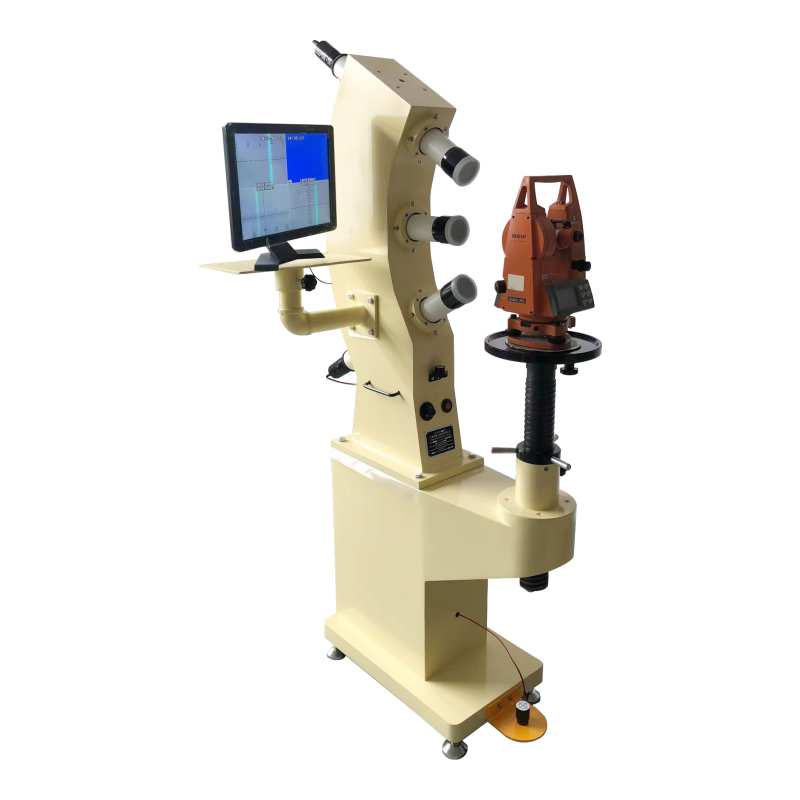
At its core, every laser collimator excels at angular measurement. When you place a total station or theodolite in front of the laser collimator and rotate its telescope, the collimator detects the tiny deviations in the reflected beam. By comparing the measured angle with the instrument’s readout, you can determine its calibration error. A high‑end laser collimator achieves resolution of 0.01 arc seconds or better, which is sufficient to verify the accuracy of even the most precise surveying gear. The non‑contact nature of the laser collimator means there is no wear on the instrument’s bearings, and the measurement is repeatable regardless of operator skill. For routine field calibration, a portable laser collimator can be set up in minutes, saving hours of downtime.
Multi‑Axis Alignment for Optical and Mechanical Systems
Alignment is where the laser collimator truly shines. Traditional alignment methods often rely on mechanical dial indicators or separate laser alignment tools, but a laser collimator provides a single reference beam that can be used to align multiple components simultaneously. For example, when assembling a laser range finder or a LiDAR sensor, the laser collimator can verify that the emitted beam is coaxial with the mechanical housing, that the receiver optics are aligned with the transmitter, and that any folding mirrors are at the correct angles. In total station servicing, the laser collimator checks that the line of sight of the telescope is parallel to the physical axis of the instrument – a critical parameter known as collimation error. The laser collimator can also project virtual targets at defined distances, eliminating the need to place physical targets in the field, which is especially useful in confined lab spaces.

Laser Beam Spot Analysis and Profiling
Perhaps the most innovative feature of modern laser collimator systems is their built‑in beam profiling capability. In the past, assessing the quality of a laser beam – its size, intensity distribution, divergence, and centroid stability – required a separate beam profiler, which was expensive and difficult to align with the rest of the measurement setup. Today, a premium laser collimator integrates a high‑dynamic‑range sensor that captures the full two‑dimensional intensity map of the incoming beam. This allows the laser collimator to not only measure angles but also to characterize the beam itself. You can use the same laser collimator to check the roundness of the spot, detect hot spots or asymmetries, measure the M² factor (beam quality), and monitor power drift over time. This is invaluable for maintaining laser diodes, fiber lasers, and solid‑state lasers used in surveying and construction equipment.
Key Advantages of Choosing a Laser Collimator
One Instrument, Endless Applications
The most compelling reason to invest in a laser collimator is its versatility. One single laser collimator replaces what used to require an alignment telescope, an autocollimator, a beam profiler, and a set of mechanical squares and protractors. This consolidation reduces not only purchase costs but also storage space, shipping weight, and training time.
Sub‑Arcsecond Accuracy for Critical Measurements
A professional laser collimator delivers angular accuracy of better than 1.0 arc second, with resolution down to 0.005 arc seconds. This level of precision is essential for calibrating total stations that will be used in high‑stakes projects like tunnel boring, bridge construction, and satellite ground station alignment. With a laser collimator, you can confidently certify the performance of your measurement instruments.
Motorized Focusing and Multi‑Wavelength Support
Top‑tier laser collimator models feature motorized focusing that automatically adjusts the objective lens to accommodate different working distances – from as close as 18 centimetres to infinity. This means the same laser collimator can be used for near‑field optical bench alignment and far‑field collimation verification. Additionally, many laser collimator units support multiple laser wavelengths (e.g., 405 nm, 532 nm, 635 nm, 850 nm, 1064 nm), making them compatible with a wide range of laser sources.
Automated Data Logging and Report Generation
Modern laser collimator systems come with user‑friendly software that connects via USB 3.0, Ethernet, or RS‑232. The software can run automated measurement sequences, record data with time stamps, and generate printable calibration certificates. This eliminates manual note‑taking errors and provides a clear audit trail for quality assurance.
Rugged, Permanently Aligned Optical Design
Unlike makeshift setups where each component must be aligned every time, a purpose‑built laser collimator has all its optical elements permanently mounted in a rigid housing. This ensures that the internal reference axis never drifts, so you can trust the readings without frequent recalibration of the collimator itself. This stability is especially important for field service teams who transport the laser collimator between job sites.
Real‑World Applications of the Laser Collimator
The laser collimator is indispensable in numerous industries:
Surveying and Civil Engineering: Calibrating total stations, theodolites, digital levels, and rotating laser levels to ensure accurate angle and distance measurements.
Aerospace and Defense: Aligning inertial navigation systems, boresighting aircraft weapons, and verifying the collimation of satellite optical payloads.
Industrial Manufacturing: Setting up CNC machine tool axes, aligning large‑format 3D printers, and inspecting the straightness of conveyor rails.
Optical Research and Development: Characterizing laser diodes, testing optical mounts, and aligning interferometers and spectrometers.
Automotive and LiDAR: Aligning autonomous vehicle sensors, verifying the angle of laser scanners, and measuring the divergence of solid‑state LiDAR arrays.
Consumer Electronics: Assembling AR/VR headsets, aligning projector optics, and calibrating smartphone camera modules.
Summary
The laser collimator is a transformative tool that combines precision angle measurement, multi‑axis alignment, and comprehensive beam spot analysis into one robust, easy‑to‑use instrument. By replacing a cabinet full of separate devices, the laser collimator cuts equipment costs, reduces setup time, minimizes measurement errors, and simplifies operator training. With sub‑arcsecond accuracy, motorized multi‑wavelength capability, automated data handling, and a permanently aligned optical construction, the modern laser collimator delivers performance that was previously only achievable in a fully equipped optical laboratory.
For professionals who rely on total stations, laser levels, and optical systems, the laser collimator is not just an improvement – it is a paradigm shift that enables faster, more reliable, and more cost‑effective measurement and alignment workflows.

Buying Guide – What to Consider When Purchasing a Laser Collimator?
To ensure you select the right laser collimator for your needs, keep these factors in mind:
Accuracy and Resolution: Look for a laser collimator with a specified angular resolution of at least 0.01 arc seconds. Higher resolution allows you to detect smaller errors in total stations and other precision instruments.
Wavelength Compatibility: Check whether the laser collimator supports the wavelengths you commonly use. Some models are designed for visible lasers (red/green), while others cover infrared (NIR) for telecom or LiDAR applications.
Clear Aperture: A larger aperture (e.g., 36 mm or more) lets the laser collimator handle wider beams and multiple laser sources without vignetting.
Motorized Focus Range: If you work at varying distances, choose a laser collimator with motorised focusing that covers a wide range (from short bench distances to infinity).
Built‑in Beam Profiling: Not every laser collimator includes spot analysis. If you need to measure beam size, divergence, or intensity distribution, select a model with an integrated profiling sensor and analysis software.
Connectivity and Software: Ensure the laser collimator comes with intuitive software that supports automated measurements, data export, and reporting. Connectivity options like USB, Ethernet, or Wi‑Fi can make integration with your existing systems easier.
Build Quality and Portability: For field use, a rugged, lightweight laser collimator with a protective carry case is essential. For lab use, you may prioritise stability and thermal compensation.
Calibration and Support: Check if the laser collimator comes with a factory calibration certificate and whether the manufacturer offers after‑sales support, firmware updates, and repair services.
Frequently Asked Questions About Laser Collimators
Q: What is a laser collimator used for?
A: A laser collimator is used to measure small angular deviations, align optical and mechanical axes, calibrate surveying instruments like total stations, and analyse laser beam profiles such as spot size and intensity distribution.
Q: Can a laser collimator replace a traditional autocollimator?
A: Yes. A modern laser collimator offers similar or better angular accuracy, plus additional features like beam profiling and multi‑wavelength operation, making it a more versatile replacement.
Q: How accurate is a professional laser collimator?
A: A high‑quality laser collimator typically provides resolution down to 0.005 arc seconds and absolute accuracy of 1.0 arc second or better, depending on the model and environmental conditions.
Q: Is the laser collimator difficult to operate?
A: No. Most laser collimator systems come with user‑friendly software that guides you through the setup, measurement, and reporting steps. Basic training is sufficient for most operators.
Q: Can I use a laser collimator outdoors?
A: Yes, many laser collimator models are designed for field use with weather‑resistant housings and battery operation. However, direct sunlight and strong vibrations may affect accuracy, so use appropriate shielding and stable mounts.
Q: What maintenance does a laser collimator require?
A: A laser collimator requires minimal routine maintenance – mainly keeping the front window and optics clean with lens tissue, and periodically checking the calibration against a reference standard. Firmware updates may be available from the manufacturer.