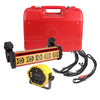
No more frantic surveying on windy days: These Data Collector Holder Clamps keep your data rock-solid

If you have ever tried to record accurate survey points while a gust of wind rattles your pole, you know the sinking feeling of watching your data collector wobble, tilt, or worse—crash to the ground. Data Collector Holder Clamps are the unsung heroes of field surveying, yet so many professionals continue to struggle with loose, wobbly, or poorly designed mounting solutions. A good set of Data Collector Holder Clamps makes the difference between a smooth, efficient day in the field and a frustrating battle against the elements.
In this guide, we will explore how the right data collector holder clamp transforms your outdoor surveying experience, what features to look for, and why partnering with a trusted manufacturer like Mountlaser is your smartest move for equipment reliability.
Why Wind Is the Surveyor’s Silent Enemy?
Wind does more than just make you uncomfortable. When your data collector is not properly secured, even a moderate breeze can transmit vibrations up the pole, causing your screen to shake and your readings to drift. Over time, constant micro-movements fatigue both the operator and the equipment. The real danger, however, is an unexpected strong gust that knocks your entire setup over, sending your expensive handheld computer crashing onto hard ground. One drop can cost hundreds or even thousands of dollars in repairs, not to mention the lost productivity while your device is out for service.

How Data Collector Holder Clamps Keep Your Data Rock-Solid?
Uncompromising Grip Strength
The primary job of any holder clamp is to maintain a death-grip on your pole. Premium clamps, like those utilizing claw-type designs, lock the data collector firmly in place, reducing movement and accidental release during operation. This innovative clamping mechanism prevents over-tightening, thereby protecting the pole from potential damage such as crushing or cracking. High-quality clamps are engineered to keep your device tight and stable under normal field movements and operational handling, eliminating the wobble that plagues cheaper alternatives.
360-Degree Flexibility Without Weakness
A rigid mount might be stable, but it is useless if you cannot see the screen. Advanced Data Collector Holder Clamps feature ball and socket mechanisms, which allow for smooth 360-degree rotation and easy angle adjustments. This enables users to position their equipment at the optimal viewing angle for data collection, whether they are standing upright, leaning over a fence, or working in a tight corner. The best designs achieve this flexibility without introducing any slop or play, giving you the best of both worlds: complete adjustability and rock-solid stability.
Built to Withstand the Elements
Outdoor surveying is tough on gear, and your holder clamp is no exception. Cheap plastic clamps become brittle in the cold and soft in the heat, losing their gripping power over time. That is why professional-grade clamps are constructed from durable anodized aluminum, ensuring longevity and consistent performance in various field conditions. This material delivers reliable stability and wear resistance for outdoor use, so the holder stands up to repeated fieldwork without degrading. Some models even use corrosion-resistant ABS materials for specific components, ensuring long-term durability even when exposed to moisture and dust.
Quick-Release Efficiency Saves Valuable Time
Time is money on a survey site, and fumbling with bolts and screws every time you need to move your data collector is a drain on productivity. Modern holder clamps feature quick-release mechanisms that facilitate fast adjustments and secure locking for efficient setup and repositioning in the field. The open-style design of many brackets allows for swift attachment and removal, making it convenient for professionals who need to reposition equipment frequently. With a simple lever or button, you can detach your data collector from the pole and reattach it in seconds, streamlining your workflow dramatically.
Anti-Extrusion Design Protects Your Investment
One often-overlooked feature of high-end holder clamps is their anti-extrusion claw bracket design. This advanced claw design locks the data collector firmly in place while preventing the clamp from digging into or deforming the pole itself. This is particularly important for carbon fiber poles, which can be damaged by excessive clamping force. By distributing pressure evenly and preventing over-tightening, these clamps protect both your data collector and your pole, reducing the risk of slips or costly repairs.
How to Choose the Right Data Collector Holder Clamps: A Buyer’s Checklist?
With so many options on the market, selecting the right Data Collector Holder Clamp can feel overwhelming. Here is a simple checklist to guide your decision.
1. Pole Diameter Compatibility
Most surveying poles come in standard diameters, with 1.25 inches (32 mm) being the most common. However, some poles are 1 inch or even larger. Before purchasing, verify that the clamp you are considering fits your specific pole diameter. Some clamps are adjustable across a range, while others are fixed-size. Look for models with flexible clamp brackets that fit a wide range of pole sizes to maximize versatility.

2. Material Quality
Do not compromise on materials. Aluminum alloy clamps are generally superior to plastic for heavy-duty fieldwork. Anodized aluminum offers the best combination of lightweight portability and rugged durability. ABS materials can be appropriate for certain components but should not be relied upon for high-stress gripping surfaces.
3. Quick-Release Mechanism
If you frequently move your data collector between different setups or share equipment among team members, a quick-release clamp is a game-changer. Look for models with reinforced hinge mechanisms that allow repeated opening and closing without loss of tension. A good quick-release should operate smoothly with one hand.
4. Weight Capacity
Different data collectors have different weights. A heavy ruggedized tablet requires a much stronger clamp than a lightweight handheld unit. Check the manufacturer‘s specified weight limit and ensure it exceeds the weight of your device. Some heavy-duty clamps can support devices up to 3 pounds or more.
5. Viewing Angle Adjustability
Consider how much flexibility you need in the field. A ball-and-socket joint offers the greatest freedom, allowing you to tilt and rotate your screen to virtually any angle. Fixed-angle clamps are simpler and often stronger but may leave you craning your neck to see the display. Choose based on the typical terrain and positions you work in.
6. Brand Compatibility
While many clamps are universal, some are specifically designed to work with certain cradle systems or device form factors. If you use a popular brand like Trimble, Leica, Topcon, or Carlson, look for clamps that explicitly state compatibility with those ecosystems. Even universal clamps should be tested with your specific device before committing to a bulk purchase.

Summary
Frantic surveying on windy days is not just unpleasant—it is a genuine threat to data accuracy and equipment longevity. By investing in professional-grade Data Collector Holder Clamps, you eliminate wobble, prevent accidental drops, and streamline your entire fieldwork workflow. From the claw-type grip that locks your device in place to the 360-degree ball joint that keeps your screen visible from any angle, every feature of a quality holder clamp is designed with one goal in mind: keeping your data rock-solid so you can focus on the job at hand.
When you are ready to upgrade your field equipment, do not settle for generic, unreliable solutions. Reach out to the experts who understand what surveyors truly need. Contact Mountlaser today to explore their full range of heavy-duty Data Collector Holder Clamps and discover why professionals around the world trust their gear to Mountlaser for quality, durability, and innovation. Your data—and your sanity—will thank you.