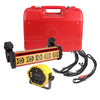
Tight deadlines and high requirements? Modern Electronic theodolites become an "efficiency accelerator" for engineering teams

In construction engineering, road and bridge construction, and large equipment installation, project teams often face two core challenges: tight deadlines and high precision requirements. Traditional optical theodolites are slow to read, prone to errors, and cumbersome to record data, often becoming a bottleneck to the overall schedule. Modern electronic theodolites, with their digital measurement, automatic calculation, and data storage capabilities, are becoming a true "efficiency accelerator" for engineering teams.
Why are traditional measurement methods inadequate when working on tight deadlines?
Many project managers have found that when numerous angle layouts, axis projections, or coordinate verifications are required on-site, traditional optical instruments require manual reading, recording, and calculation for each point measured. A simple closed-loop measurement can take several hours, and data transcription is prone to errors. Furthermore, optical theodolites are almost unusable in low light or at night. These pain points directly slow down the overall construction pace.
How do electronic theodolites achieve "one-time measurement, immediate usability"?
Electronic theodolites, equipped with built-in angle encoders and microprocessors, can display real-time digital readings of horizontal and vertical angles with an accuracy of 1 second or even 0.5 seconds. Operators simply need to aim at the target, and the angle value appears instantly on the screen, eliminating the need for estimation or a notebook. Crucially, many digital electronic theodolites support data export via Bluetooth or USB flash drive, allowing measurement results to be directly imported into CAD or layout software, avoiding secondary input errors.

Four Scenarios Prove Electronic Theodolites are the First Choice for Projects with Tight Schedules
Scenario 1: Steel Structure Installation – Rapid Alignment of Bolt Holes with Beam Axis
During steel structure hoisting, the verticality of columns and the horizontality of beams require repeated calibration. Using Electronic theodolites with a laser eyepiece, a single person can read the vertical angle deviation within seconds and guide correction through a digital display. Compared to traditional methods, the installation time for each column is reduced by an average of 40%.
Verticality Control Using High-Precision Electronic Theodolites
For high-rise steel columns exceeding 20 meters, high-precision electronic theodolites are recommended. Their automatic compensator eliminates errors caused by instrument tilt, ensuring that the vertical deviation of each column section is controlled within 1/1000 of the allowable limit.
Scenario 2: Road Centerline Laying Out – Rapid Determination of Curved Section Coordinates Per Pile
In highway curve or ramp construction, a center stake needs to be placed every 5-10 meters. Traditional methods require calculating the deflection angle and distance, then adjusting the angle point by point. However, Electronic theodolites have a built-in coordinate inverse calculation program. Simply input the design coordinates, and the instrument automatically guides the required rotation angle and distance. Surveyors do not need any calculations; they can simply aim at the prism to complete the laying out. The laying out time for a 500-meter curved section can be reduced from 2 days to 4 hours.
Scenario 3: Interior Decoration and Equipment Installation – Precise Positioning of Embedded Components
Large laboratories, hospitals, or factory production lines have extremely high requirements for equipment foundation positions. Electronic theodolites, in conjunction with a laser receiving target, can achieve a positioning accuracy of ±2 mm within a 50-meter range. Meanwhile, its electronic bubble and tilt compensation functions ensure rapid leveling even on rough ground, greatly reducing the hassle of repeated setup.
Recommended Electronic Theodolite Configuration for Equipment Foundation Positioning
It is recommended to choose an electronic theodolite with laser-guided point alignment, which allows for clear location of ground reference points even in dimly lit indoor environments, avoiding line-of-sight errors.
Scenario 4: Nighttime or Tunnel Construction – No Additional Lighting Required
Because the Electronic Theodolites' display has a built-in backlight and the telescope reticle is LED-illuminated, it can operate normally even in completely dark tunnels. With the active-emitting prism, a surveying team can work continuously for 12 hours without being affected by light, which is crucial for municipal projects that require nighttime work.
How to Choose the Right Electronic Theodolites for Your Engineering Team?
There are many types of electronic theodolites on the market. Here are some key long-tail indicators to help you choose the right model:
Accuracy Class: For general earthwork surveying, a 2-second accuracy class is recommended; for high-rise buildings and precision installations, a 1-second accuracy class Electronic Theodolites is recommended.
Compensator Type: Single-axis compensation can only correct horizontal angles, while dual-axis compensation can correct both horizontal and vertical angles simultaneously, suitable for slopes or windy environments.
Data Interface: USB, Bluetooth, or RS232. If the team uses BIM or layout software, models with Bluetooth transmission are preferred.
Battery Life: Lithium-ion battery models typically operate continuously for over 20 hours, superior to dry-cell battery models.
Protection Rating: IP54 is the basic requirement; IP65 is recommended for tunnels or open-pit mines.

Precautions for Using Electronic Theodolites
Although Electronic Theodolites are easy to operate, the following details directly affect the quality of results:
Regular Calibration: Check the two-axis difference and compensator zero point every 3 months or after severe vibration.
Avoid Strong Magnetic Fields: Electromagnetic interference near large motors or high-voltage lines may cause angle fluctuations.
Temperature Adaptation: When moving from an air-conditioned vehicle to a high-temperature outdoor environment, allow it to stand for 15 minutes before performing precise measurements to avoid lens fogging or errors caused by internal temperature differences.
Prism Constant Matching: When using non-original prisms, the prism constant must be correctly set in the instrument; otherwise, systematic deviations will occur in distance measurement (e.g., when used with a total station).
Need Precise Measurements? Contact Mountlaser Now
If your engineering team is looking for a surveying tool that can truly handle tight deadlines and high demands, whether for building layout, steel structure installation, or road construction, please feel free to contact us. The Mountlaser team provides professional technical consultation, on-site demonstrations, and after-sales calibration services.
Summary:
In today's increasingly competitive engineering industry, efficiency equals profit, and accuracy equals reputation. A modern electronic theodolite not only helps teams complete tasks with high quality within tight deadlines but also reduces rework and lowers labor costs, truly becoming an "efficiency accelerator" for projects. Choosing the right electronic theodolite means choosing to confidently handle any demanding schedule.