Machine Control Receiver Guide MCR360C vs MCR360M vs KMR02
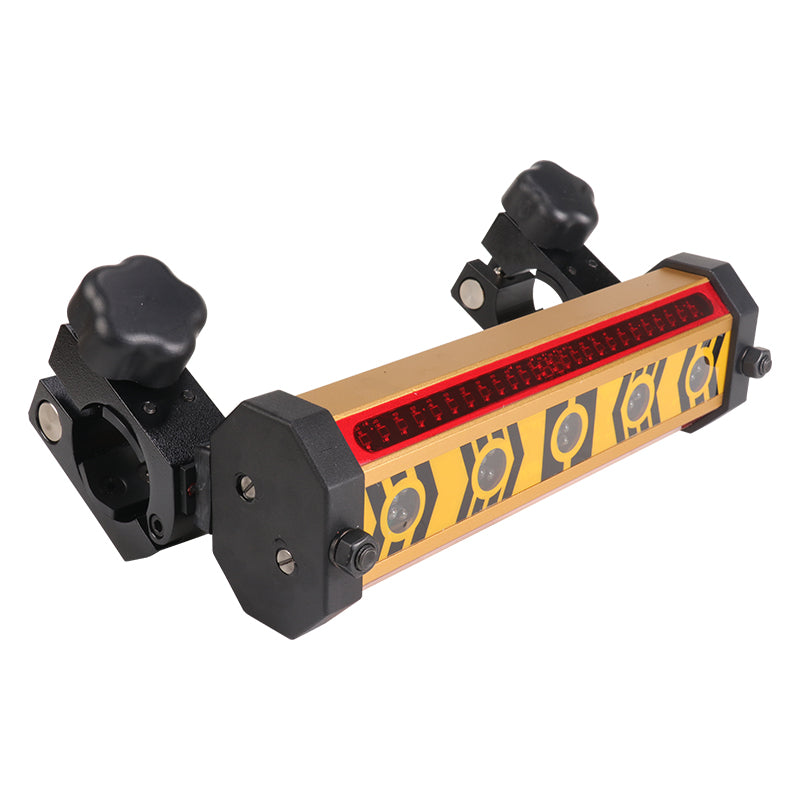
Quick answer: Choose a machine control receiver by its mounting method, laser compatibility and intended control workflow. Mountlaser lists the MCR360C with a screw clamp and the MCR360M with a magnetic mount; both have a 25 cm receiving window and 360° laser reception. For a tractor leveling installation, choose the KMR02R for a compatible red laser or KMR02G for a compatible green laser, then confirm whether your workflow needs the KMRC02 controller and hydraulic connections.
Mountlaser supplies the three receiver options compared here. This guide compares the three products in Mountlaser's Machine Control Receiver collection. It explains what to check before buying, how laser grade guidance differs from hydraulic control, and which specifications need confirmation for your machine.
What does a laser machine control receiver do?
A laser machine control receiver detects a reference beam from a rotating laser instrument and indicates the receiver's position relative to that reference. The operator uses this information to judge elevation during grading or leveling. A receiver, a rotating laser and a suitable mounting arrangement work together; the receiver alone does not establish the reference plane.
Keep the signal type clear when planning a purchase. The products discussed here detect rotating laser beams. Their laser reception specifications do not establish GNSS, RTK correction or total station tracking capability. If your project requires those positioning methods, request a separately verified system specification.
Also separate guidance from actuation. A display can show the operator that an implement is above or below the reference. Moving a hydraulic implement automatically requires the appropriate controller, wiring and compatible valves. A receiver or remote display should not be treated as a complete automatic hydraulic system without checking the configuration.
MCR360C vs MCR360M vs KMR02: comparison at a glance
| Product | Published distinction | What to verify |
|---|---|---|
| MCR360C | Screw clamp; 25 cm window; 360° reception; IP66 metal enclosure | Clamp dimensions, mounting position and exact supplied display/cables |
| MCR360M | Magnetic mounting; 25 cm window; 360° reception; IP66 metal enclosure | Suitable ferrous mounting surface and exact supplied configuration |
| KMR02 | KMR02R for red lasers; KMR02G for green lasers; clamp mounting; external DC 10–30 V input | Receiver variant, controller compatibility and whether the order is receiver-only or a complete system |
The table identifies practical purchase questions rather than a universal winner. Select the mounting arrangement and system architecture first, then compare the exact specification supplied with the quotation.
When does the clamp-mounted MCR360C make sense?
The MCR360C product page identifies a screw clamp attachment. It is an option to investigate when your installation provides a suitable mounting member and you want a mechanically clamped receiver. Ask for the clamp's supported dimensions before choosing a mast or bracket. The mounting hardware must fit the actual machine installation.
The page also describes a remote display. Confirm the display and connection cable in the order contents, and plan a location where the operator can read it during the intended operation. The most useful display arrangement is one that can be seen without the receiver being placed where the machine structure repeatedly blocks the laser.
A purchasing conversation should therefore cover both attachment and visibility. Send the supplier the proposed mounting location, relevant dimensions and rotating laser model. Those details are more useful for a compatibility check than the machine's brand name alone.
When should you consider the magnetic MCR360M?
The MCR360M product page specifies integrated magnetic mounting. Investigate this model when the intended location offers a suitable ferrous surface. Inspect the actual contact area and follow the supplied mounting instructions; magnetic attachment should not be assumed to work equally well on every machine surface.
The product page lists a 200 m receiving distance. Treat this as the published receiver specification, then verify the conditions applicable to your laser and installation. A nominal receiving distance does not establish that every point on a worksite will have an unobstructed signal.
Its page also describes a cabled remote display. Confirm cable routing and available length as part of the installation plan. A display that is convenient in the cab still depends on a receiver positioned to detect the reference beam.
How does KMR02 relate to the KMRC02 leveling system?
The KMR02 product page identifies KMR02R for red lasers and KMR02G for green lasers, with clamp mounting and external DC 10–30 V input. KMR02 is the receiver product name shown in the collection. KMRC02 is the control system named in the supplied laser land leveling manual. These names identify related components and should not be used interchangeably when ordering.
The KMRC02 manual describes a system kit comprising a KMR02R/02G laser receiver, a KMRC02 control box, interconnect cables and power cables with clamps. It lists a 260 mm reception window, 360° reception, a 300 m operating radius, IP66 protection and external DC 10–30 V power for the described system. These are system-manual specifications; confirm that the quoted KMR02 variant and package match them.
The manual describes three connections on the controller: power input, receiver input and valve output. It also identifies manual and automatic operating modes. In manual mode, the up/down switch provides raise/lower control. In automatic mode, the controller drives hydraulic solenoids based on the laser signal.
This architecture is relevant when the purchasing goal includes implement movement rather than a visual elevation indication alone. Before ordering, confirm the controller, harness and hydraulic valve arrangement with the supplier and installer. Do not assume that adding any laser receiver to an existing machine creates a compatible automatic leveling system.
Five checks before choosing a machine control receiver
1. Define the job and control method
Describe the intended task: checking elevation during excavation, guiding a grading pass, or controlling a tractor-mounted leveling implement. Then state whether the operator will make adjustments manually or whether a compatible controller must operate hydraulic valves. This distinction determines which components need to be quoted.
2. Confirm your rotating laser
Provide the laser make, model and relevant beam specification. Ask the supplier to confirm compatibility with the exact receiver variant. Broad product descriptions are useful for initial screening, while a model-specific confirmation is more useful for procurement.
3. Check mounting and beam visibility together
Measure the proposed attachment point and assess how the machine structure moves around it. A convenient attachment location may still be unsuitable if it regularly obscures the beam. The receiver needs a practical view of the laser during the operation you intend to perform.
4. Request the exact electrical and accessory specification
Ask for the receiver's power requirements, included charger if applicable, display, harness and connector details. For a KMRC02 installation, verify the controller's DC supply requirements and valve connection arrangement against the actual equipment. Use the supplied instructions for the delivered configuration.
5. Agree how performance will be checked
Ask what the stated accuracy or sensitivity figures represent and which settings they apply to. Receiver detection specifications should not be presented as a guarantee of finished surface accuracy. Agree an appropriate setup and checking procedure for your installation and required result before production work.
Practical setup questions for your supplier
A useful enquiry includes the machine type, implement, rotating laser model, mounting dimensions, required operating area and desired control method. If a controller is needed, include the available supply and hydraulic system information requested by the installer.
Request an itemized package list. This helps establish whether you are buying a receiver, a receiver with a remote display, or a system with a controller and harness. It also makes it easier to identify which parts must already be present on the machine.
Keep the delivered model labels and manual together. The supplied KMR01 manual uses MR360 terminology internally, while current product pages use MCR360 names. A similar appearance or related model family is not enough to transfer every specification between products. Where the label, listing and manual differ, obtain a written model-specific clarification.
Frequently asked questions
Does a laser machine control receiver work without a rotating laser?
For the laser reference workflow described here, it needs a compatible rotating laser instrument to supply the reference beam. Confirm whether that instrument is included or must be supplied separately.
What is the main difference between MCR360C and MCR360M?
The clearest published distinction is mounting: MCR360C uses a screw clamp, while MCR360M uses a magnetic mount. Check the detailed specification and included accessories for the exact unit being quoted.
Does 360° reception mean the beam cannot be blocked?
No. Reception around the receiver does not remove physical obstructions. Position the receiver so that the laser can reach it during the intended machine movement.
Is the KMR02 receiver the same as the KMRC02 system?
No. KMR02 identifies the receiver product, while the supplied KMRC02 manual describes a control system with a receiver, controller and connections. Confirm the package contents before ordering.
Can a remote display control hydraulic valves?
A remote display provides information to the operator. Automatic valve control requires the appropriate controller and compatible connections. The KMRC02 manual describes that controller-based arrangement.
Choose your next step
Compare the MCR360C clamp-mounted receiver, MCR360M magnetic receiver and KMR02 machine receiver. For help selecting a configuration, contact Mountlaser with your machine, laser model and intended workflow.
Sources and specification scope
Product distinctions are based on the linked Mountlaser product pages. KMRC02 system details are based on the supplied KMRC02 Laser Leveling System User Manual, sections 1–6. The supplied KMR01 Machine Control Receiver Manual, product overview and specifications, was used to identify model-family terminology; its figures have not been assigned to every current listing. Prepared November 6, 2026. Confirm current package contents and model-specific specifications before ordering.
-
Posted in
machine control receiver